
This content requires the base game Trainz Railroad Simulator 2019 on Steam in order to play.
## About This Content
This package includes the “C&O 2-6-6-6 H8” locomotive and a brand new detailed
session.
Quinnimont was a marshalling yard for coal loads from the surrounding mines.
Trains were assembled here to be shipped to Clifton Forge and beyond. Empty
cars were also made-up here for the mines in the area.
The first European settler on the wide river bottom at Quinnimont, below the
mouth of Laurel Fork, was Jacob Smith, who arrived in 1827 and whose family
was joined by others a few years later. Smith married three times and begot 24
children. The name “Quinnimont” is derived from the Latin roots for “five
mountains,” said to describe the five heights formed by the surrounding walls
of the New River Gorge.
Quinnimont was one of two towns in the New River Gorge that became major
shipping points. The other, at Thurmond, began to develop in the 1890s, while
operations at Quinnimont commenced 20 years sooner. Even before the railroad
through the gorge had been fully completed to Huntington, the Quinnimont
operation was able to ship coal eastward to locations in Virginia.
The first industry in the New River Gorge, the Quinnimont Charter Oak & Iron
Company, was organized in 1870 to build and operate an iron furnace at
Quinnimont near the mouth of Laurel Creek. A short branch line railroad of
about one and half miles was built from the C&O mainline to the mine by the
iron company. The furnace operated for only three years, manufacturing common
pig iron using coal extracted locally and hematite shipped in from Rich Patch,
VA.
Although the iron business was not a financial success the coal of the area
proved to be of excellent quality for use in iron production. In 1873, under
operation by Colonel Joseph L. Beury, coal mines were opened on the mountain
above Laurel Creek, to supply the furnaces of the Longdale Iron Company in
Allegheny, VA. From this mine the first shipment of the first coal from the
New River Coal Field was made. A monument standing along the bank of the New
River at Quinnimont was erected in honor of Col. Beury at a cost of $30,000.
The inscription on the monument reads: “The first New River Smokeless Coal was
mined and shipped from Fire Creek seam at Quinnimont by Joseph Lawton Beury in
1873. This memorial erected by his associates in the New River Field.” The
twenty-five foot tall granite monument is said to weigh fifty-five tons.
Photos of the Beury Monument can be viewed at the website.
Beury remained at Quinnimont until 1876, at which time he moved to Fire Creek,
where, in association with Messrs. Jenkin Jones, John Freeman, and others, he
opened the Fire Creek mine. A circa-1879 map of mines in the New River
Coalfield shows the “Pa. & Va. I. & C. Co.” as operating a mine near
Quinnimont, located about 1.5 from Quinnimont on the south side of Laurel
Creek. Transactions of the American Institute of Mining Engineers, published
in 1880, noted that the Quinnimont coking plant of the Pennsylvania and
Virginia Iron and Coal Company was at that time the largest in the New River
Field, with 100 coke ovens in operation.[1} The May 25th, 1887 edition of the
The Coal Trade Journal stated that there were 105 coke ovens in operation at
Quinnimont.[2]
A station was established in Quinnimont in 1874, being replaced and
supplemented by additional structures beginning in 1896. By the 1890s, a
railroad boarding house started operation at Quinnimont and a store was
opened. A post office was established at Quinnimont in 1877 which continued to
operate until 1947 according to the National Park Service.
The Quinnimont Coal and Iron Company was incorporated in West Virginia on June
23, 1883 by investors of Philadelphia, PA and Hartford, CT to “mine coal and
iron, and cut and manufacture lumber”. The company’s main office were in
Philadelphia, and a branch at Quinnimont. The company operated several mines
near Quinnimont from 1883 through 1929 named as: Big Q, Old Mine, Quinnimont,
Big Q No. 3, and Lickbranch. Several years later, the mine known as “No. 1”
showed a period of brief production during the years 1950-1951. Another
company, the Quinnimont Coal and Quinnimont Smokeless Coal Co., operated the
Quinnimont mine during in 1952 and the Quinnimont Coal Co. operated the No. 1
mine during 1953.
In 1890, the short railroad branch along Laurel Creek was extended to to
Brownwood, a distance of 4.8 miles. A large mine would be opened at Layand in
later years on this branch, a point about 5.5 from Quinnimont. This short
branch line was operated by the mining company until 1899. From 1899 until
1902 the C&O leased the branch line and assumed operation of the line. From
1902 until 1906, the mining company resumed operation of the railroad. In 1907
the line was sold to the C&O, and thereafter known as the Laurel Creek Branch.
It was not until 1901 that the C&O completed the Piney Creek branch line from
Quinnimont into the yet-untapped coal fields of Raleigh County in the vicinity
of Beckley, WV. From the railroad’s Piney branch, additional branch lines were
soon opened, which resulted in the railroad building a large marshaling yard
and locomotive servicing terminal at Raleigh, about 11 miles from Quinnimont.
Because of this, the terminal facilities at Quinnimont remained modest
compared the Thurmond’s. However, like Thurmond, Quinnimont became a major
staging area for inbound and outbound freight. All the coal coming off the
Piney Creek Subdivision (and it branches) and from the Laurel Creek Branch
moved into Quinnimont’s large rail yard, to be made up into trains by
switching crews at Quinnimont.
Trains were often up to a 130 cars in length which would be hauled to Hinton
where they would pick up a helper engine for the trip up to Allegheny on the
way to Clifton Forge.
By the 1920s, many of the people living in Quinnimont worked on the railroad,
on runs to Thurmond or on the Laurel Creek or Piney branch lines and
Quinnimont.
Quinnimont had a store, post office, church, and two schools. Two passenger
trains ran daily from Quinnimont to Beckley, and another ran up Laurel Creek
to Layand.
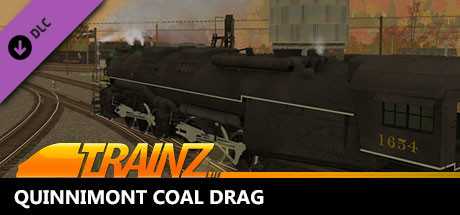
Trainz 2019 DLC: Quinnimont Coal Drag
| Minimum System Requirements | Recommended System Requirements | |
| CPU | Intel 'i' series/AMD K10 series introduced 2009 onwards. 2 physical cores, 2Ghz 64 bit | Intel i5 3330/AMD FX 8350 or better, Quad physical core, 64 bit, 2.3Ghz or better |
| RAM | 4 GB RAM | 8 GB RAM |
| OS | Windows 7 64bit | Windows 10 64bit |
| Graphics Card | NVIDIA GT 430 or better/ AMD ATI 5550 or better | NVIDIA GTX 660 or better/ AMD HD 6950 or better |
| Direct X | Version 11 | Version 11 |
| HDD Space | 500 MB available space | 500 MB available space |
| Minimum System Requirements | Recommended System Requirements | |
| CPU | i5 2 Ghz | i5 2.3 Ghz |
| RAM | 6 GB RAM | 8 GB RAM |
| OS | 10.9 | 10.10 |
| Graphics Card | Intel Iris Pro with 1GB VRAM supporting OpenGL 3.3 | Dedicated Graphics card with 1 GB VRAM supporting OpenGL 3.3 |
| HDD Space | 500 MB available space | 500 MB available space |